 AUTHORIZED JEKKO DEALER
 AUTHORIZED HYRAX DEALER
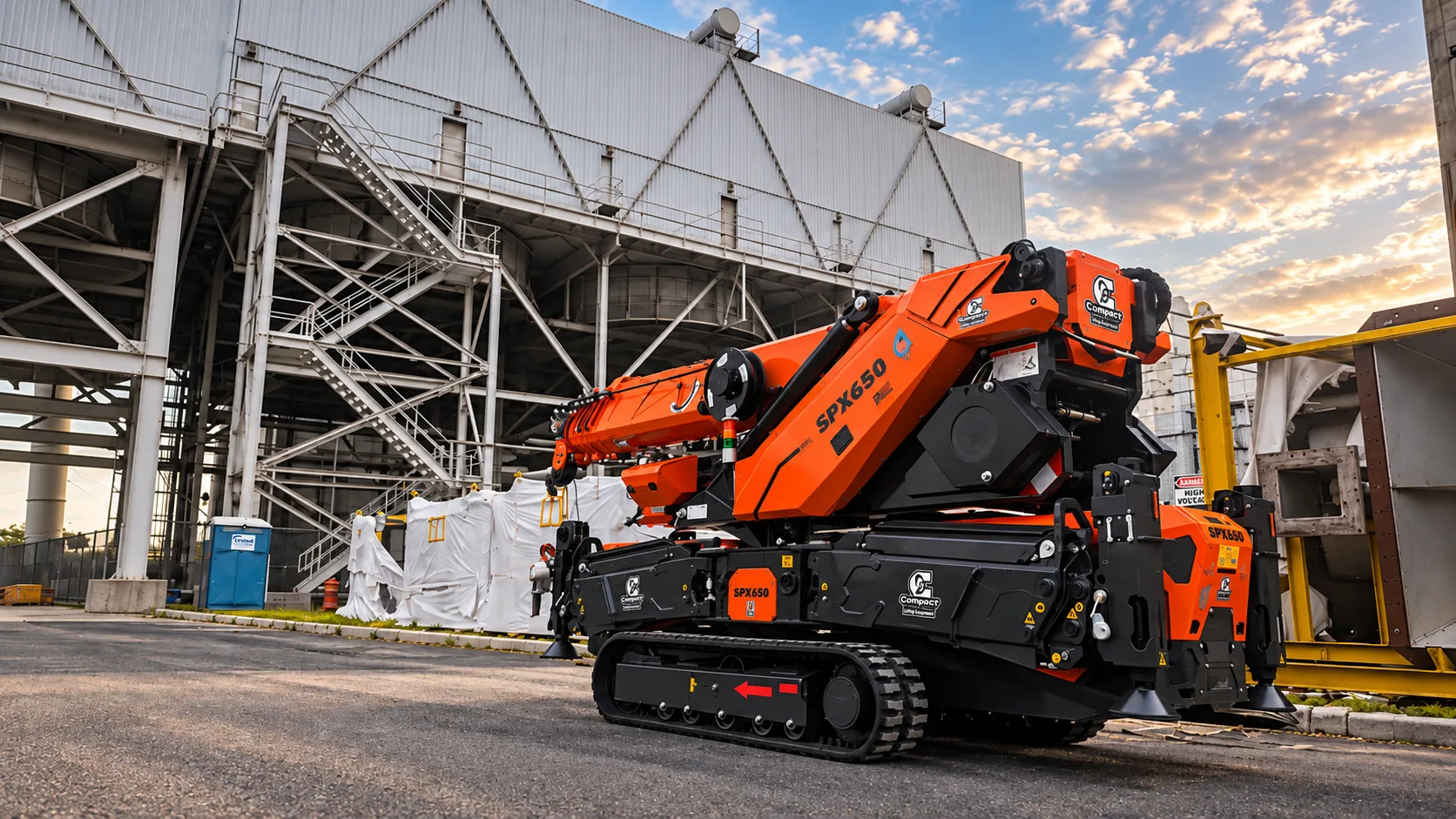
Process plants are built densely. Pipe racks cross access roads, exchangers are stacked, and the pump that needs to move may sit beneath a mezzanine with little clearance. A truck crane at the nearest open pad can be far from the pick with obstructions in the way. A mini crane may improve the geometry by reaching a setup area closer to the load, subject to the access route, chart and supporting structure.
01The crane goes where the truck crane cannot
The SPX650 CL-2 technical data prints a closed-track width of 3 ft 4 in. That makes tight plant routes worth evaluating, but it says nothing about whether an elevator or grating deck can support the machine. Verify the complete route and load path. Independent outriggers can help position pads around obstacles when the resulting setup is approved and charted.
Working close can improve the available chart capacity because radius matters. A mini crane may reach beneath a rack and use an approved jib configuration to approach a load a larger crane cannot reach directly. Compare the actual load and configuration against the correct chart; crane size labels alone do not establish suitability.
02Turnarounds run on hours, not days
One machine, one operator, one aisle
During a turnaround every hour of crane time is scheduled weeks out and every conflict costs a shift. A mini crane takes the small and medium picks off the big-crane schedule entirely: motors, gearboxes, valves, control-valve bodies, agitator drives, and exchanger heads move on their own timeline with a single operator on a radio remote standing where the load is. The big crane stays on the lifts that actually need it.
Set up in minutes, move to the next unit
After a completed pick, the crane can be stowed and tracked to another approved setup area. Plan each move, clear the route, and use the personnel required by the lift plan. Setup and repositioning time depend on ground conditions, access, configuration and site controls.
03Battery power inside a process unit
Battery configurations of the SPX650 and SPX532.2 avoid engine exhaust at the point of use. Confirm charger supply, runtime and any permission to operate while connected for the specific unit. Battery power does not itself establish suitability for a classified hazardous area; the facility must approve the equipment and work controls.
For outdoor process areas where the site permits a diesel machine, the SPX527 is another option to evaluate. The site's hot-work, confined-space and hazardous-area requirements apply to the actual equipment and activity, regardless of its size or power source.
- No engine exhaust at the machine; site air-monitoring and hazardous-area controls still apply
- Confirm the correct electrical supply and charger connection for the unit
- Follow the unit-specific instructions for charging and operation
- Radio remote puts the operator at the load with a clear view of the rack, the flange, and the crew
04What gets lifted at a plant
- Rotating equipment: pumps, motors, gearboxes, and blower assemblies out of foundations under mezzanines
- Heat exchangers: bundles, channel heads, and shell covers pulled and reset in the rack
- Valves and piping: large control valves, relief valves, and spool pieces threaded through pipe racks
- Electrical: MCC sections, transformers, and switchgear into substations and motor-control rooms
- Instrumentation and analyzers: shelters and cabinets set on elevated platforms
- Structural: grating, handrail sections, platform steel, and stair stringers during shutdown repairs
05Grating, slabs, and pipe-rack decks
Plants contain surfaces that may not be rated for a crane: grating, trench covers, sumps and elevated slabs over pipe trenches. Obtain the configured machine weight and manufacturer outrigger reactions before placing the machine or a pad on them. A lower total weight than another crane does not establish structural adequacy.
CLE can help prepare the machine data and proposed pad layout for the plant engineer. The Outrigger Simulator provides preliminary planning output; it does not replace manufacturer data, an engineered load path or site approval. Supply the actual configuration and supporting-surface information with the request.
06Three machines for the plant
The SPX650 offers an 11,020 lb headline capacity, with battery operation in its CL-2 configuration and a closed-track width of 3 ft 4 in. The SPX1280 has a 17,637 lb headline capacity and a 4 ft 9 in closed-track width in the referenced technical data. The SPX527 is a diesel alternative for sites that permit it. Match each actual pick to its radius, boom, jib and stability chart rather than choosing from headline capacity alone.
07When a mini crane is the right call
- The pick is inside a pipe rack, under a mezzanine, or in a building the truck crane cannot reach
- The load is small or medium and would otherwise wait on the big-crane schedule
- The unit is enclosed and exhaust is not permitted
- Setup surface is grating, a slab over a trench, or an elevated deck that needs documented pad loads
- Multiple picks in one unit need one machine that can move itself between them
- The road cannot close for a crane pad without stopping trucks into the unit
Compact Lifting Equipment rents and sells battery-electric and diesel Jekko mini cranes from Pottstown, PA, and delivers to plants and refineries across Pennsylvania, New Jersey, Delaware, and the Mid-Atlantic. Send us the load, the radius, the rack drawing, and the surface, and we will match the machine and the chart.
Manufacturer sources and configuration notes
Jekko SPX650 TD REV2.0, 9 May 2025, p 9 (CL-2 dimensions and headline capacity); p 16 (stability selection). CLE unit variant and later revision remain to be confirmed.
Jekko SPX1280 TD Rev.8, 19 January 2023, p 5 (CL3 dimensions and headline capacity); p 9 (counterweight-dependent stability selection).
Jekko SPX527CDH-2 TD Rev.1, 22 February 2018, p 4 (43¼ in width and 77⅛ in transport height); p 5 (5,940 lb static lifting capacity).