 AUTHORIZED JEKKO DEALER
 AUTHORIZED HYRAX DEALER
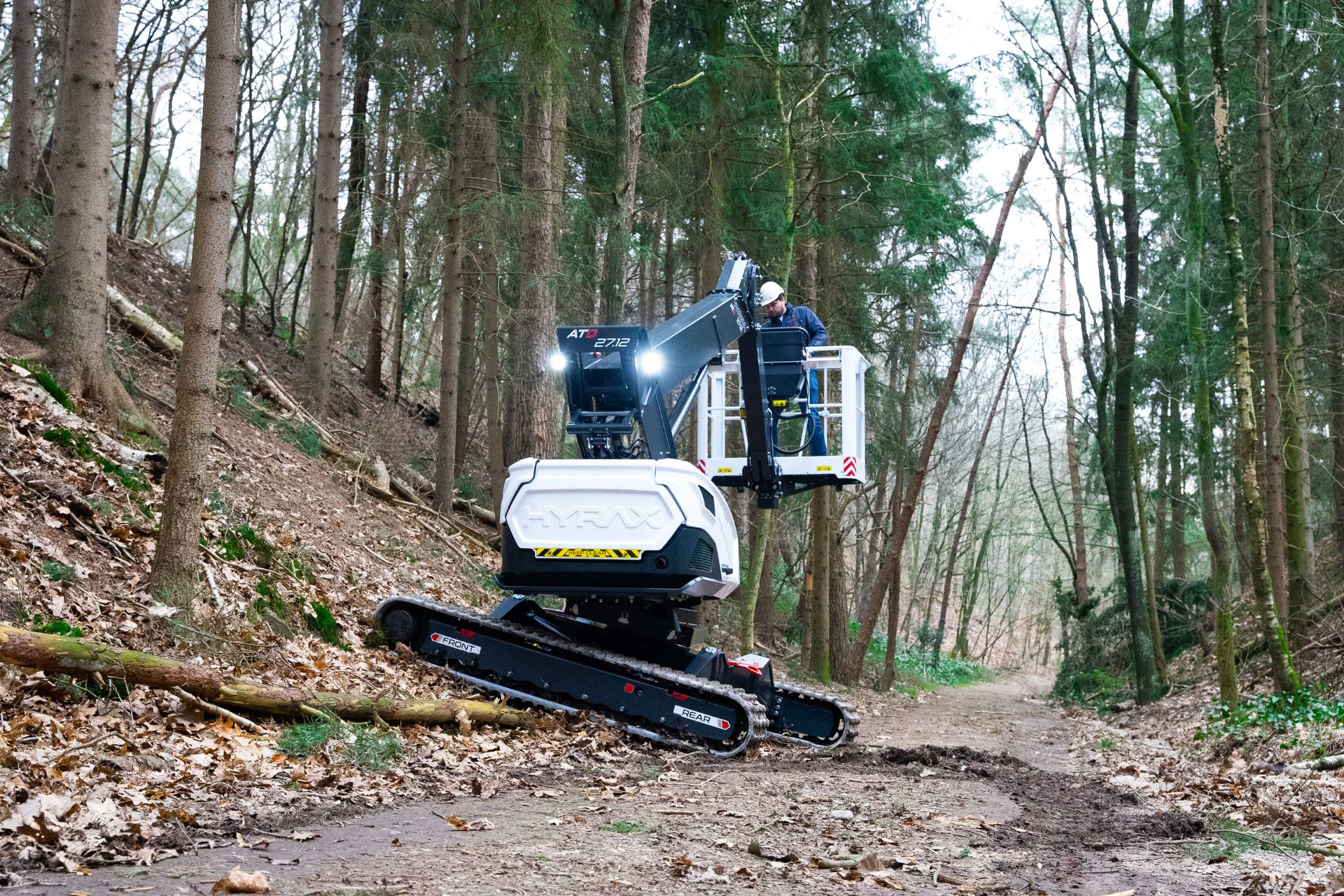
When people compare aerial lifts, they usually start with working height. But on real jobsites the deciding factor is almost always how the machine gets to the work and what it does to the ground once it's there. That's where a tracked lift and a wheeled lift part ways, and it's why a lightweight Hyrax spider lift reaches jobs a scissor or wheeled boom lift simply can't.
01The real difference is on the ground
Tracks spread the load; tires concentrate it
A wheeled lift carries its entire weight on four contact patches not much bigger than your hand. A tracked machine spreads that same weight across two long rubber tracks, so ground pressure drops dramatically. Lower pressure is what lets a spider lift cross turf, pavers, and finished floors that a heavier wheeled machine would rut, crack, or sink into.
Traction where wheels slip
Tracks also grip. On grades, gravel, mud, and uneven grade transitions, a wheeled lift loses traction and reaches its slope limit quickly. Non-marking rubber tracks keep pulling and climb inclines that would strand a tire, then self-level so the mast stays plumb on ground that's anything but.
02Lightweight by design
The Hyrax is built light for its class, and that single trait unlocks everything else. A lighter machine puts less load on the ground under it, which means it can work on suspended slabs, over basements, on rooftop terraces, and inside finished buildings where a heavier wheeled lift is simply too much for the floor.
Light also means easy to move and easy to place. A compact, low-weight lift fits on smaller trailers, tucks through gates and doorways, and can be repositioned around a site without tearing up the surface it rolls over. You get real aerial reach in a package that behaves more like a piece of equipment you can bring anywhere.
If floor capacity is the question on your job, our floor-loading guide walks through travel loads versus point loads and when a lift needs an engineer's sign-off.
03Full reach with no outriggers
Here's the part that sets the Hyrax apart from most spider lifts: it reaches its full working envelope on its tracks, with no outriggers to deploy. There are no legs to set, no pads to level, and no cribbing footprint to plan around. You drive it in, and it's ready to work.
That changes how the machine behaves on site. Setup is faster because there's nothing to extend and stabilize. The footprint stays tight, so the lift works in aisles and corridors that can't spare the width for outrigger spread. And because nothing is anchored to the ground, you can reposition to the next pick without tearing down, a real advantage on jobs with many small moves.
- Faster setup: nothing to extend or level
- Tighter footprint for aisles and corridors
- Reposition between picks without tearing down
04Where tracked lifts win
Put it together and the tracked lift owns the jobs that give wheeled machines trouble: anything soft, sloped, finished, or tight.
- Turf, landscaping, and soft or graded ground
- Finished floors, atriums, and interior work
- Slopes and grade transitions that stop tires
- Tight footprints with no room for outrigger spread
- Jobs with many quick repositions
See the full lineup and reach numbers on our tracked aerial lifts page.
05When a wheeled lift still makes sense
Tracks aren't the answer to everything. On long, flat, hard runs (a warehouse floor, a paved lot, a level slab where you're covering distance all day), a wheeled lift rolls faster and repositions with less effort. If the ground is uniformly firm and level and you're not worried about surface protection, wheels can be the more efficient tool.
The honest rule of thumb: match the machine to the ground. When the surface is firm, flat, and forgiving, wheels are fine. The moment it turns soft, sloped, finished, or tight, a lightweight tracked lift is what keeps the job moving.
06Matching a Hyrax to your job
Working height gets you in the door, but access, ground conditions, and setup are what decide the day. Tell us where the work is and what's under the machine, and we'll match you to the right Hyrax, or tell you honestly when a wheeled lift is the better call.