 AUTHORIZED JEKKO DEALER
 AUTHORIZED HYRAX DEALER
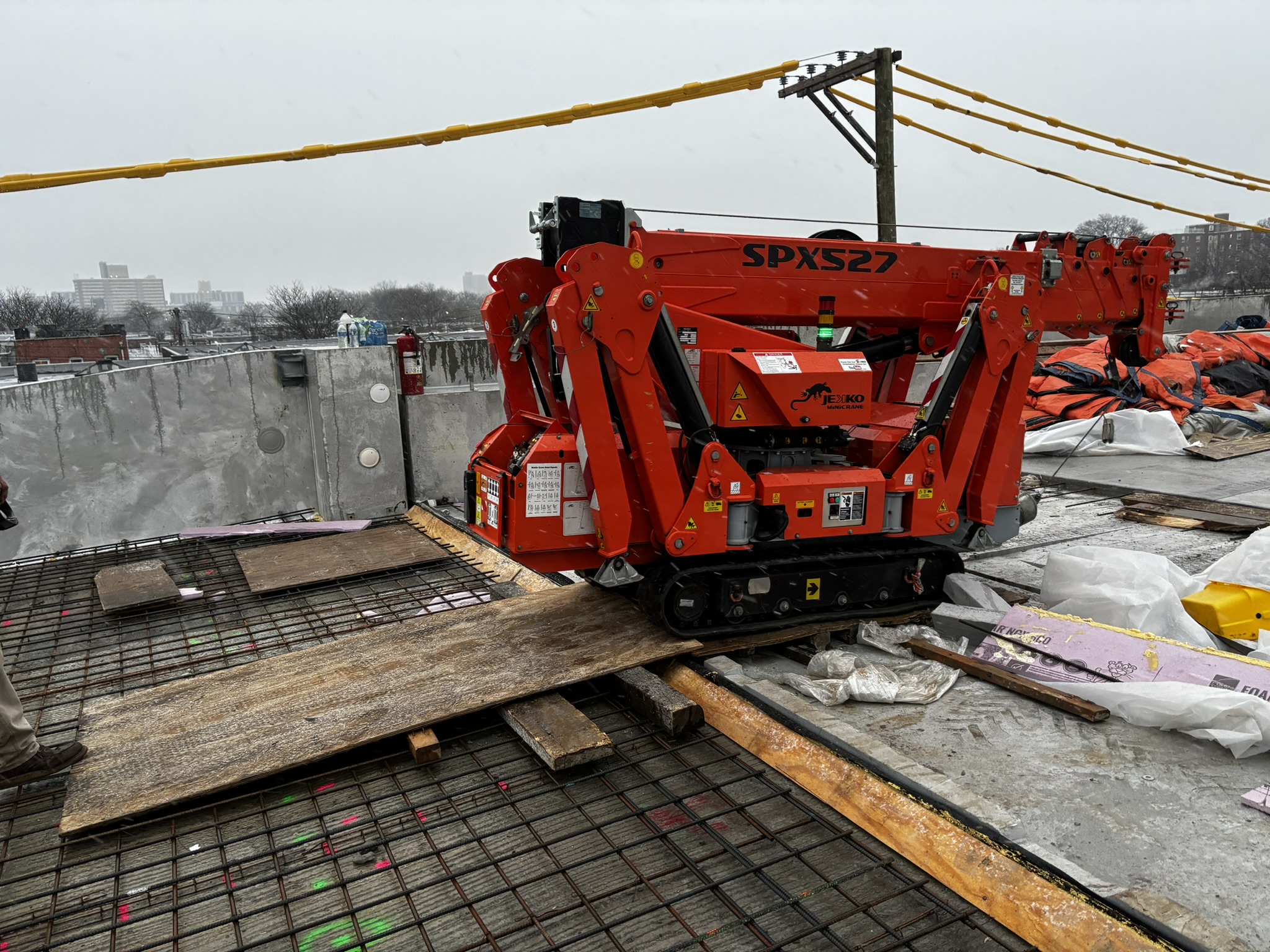
Compact Lifting Equipment was started in December 2025 after we repeatedly saw the same problem on jobsites: contractors needed to lift material in tight, difficult, or restricted locations, but could not find the right equipment through traditional rental channels.
The load might not have been unusually heavy. The real problem was access. A contractor might need to move a glass panel through a narrow opening, place an HVAC component inside a building, install machinery around existing production equipment, or reach over an obstacle without closing an entire street. Traditional equipment was often too wide, too heavy, too tall, too loud, or unable to operate in the available setup area.
We started Compact Lifting Equipment to solve that problem.
The gap between available and actually suitable
Traditional rental houses carry equipment that works for a broad range of customers. That model makes sense, but specialized projects do not always fit a broad category. A general yard offers a forklift, telehandler, boom lift, or conventional crane: machines that create new problems when the project involves narrow doors, finished interior floors, restricted overhead clearance, limited outrigger space, indoor-emission requirements, sensitive landscaping, active manufacturing areas, occupied buildings, long reach with a light load, or precise glass and machinery placement.
Customers were finding equipment that could theoretically lift the weight, but not equipment that could physically reach the work area and complete the lift efficiently. That distinction became the foundation of CLE.
We focus on the entire lift
Maximum crane capacity is only one part of equipment selection. A crane advertised as an 8,000 lb machine cannot necessarily lift 8,000 lb from every position: capacity changes with radius, boom length, boom angle, outrigger configuration, and the direction of the lift.
Before recommending a machine, we ask five questions:
We also consider floor loading, ground conditions, overhead restrictions, power availability, transportation, and the attachment needed to control the material. That lets us recommend a machine based on the actual lift, not the largest number on a spec sheet.
Built for restricted access
Every category in the fleet solves a different access or handling problem: Jekko lithium mini cranes and Maeda dual-power spider cranes for lifting over obstacles, electric mini pickers for carrying material through a building, Broderson carry decks for repeated industrial lifts, HYRAX self-leveling tracked lifts for elevation on sloped or uneven ground, plus glass manipulators, vacuum lifters, and ground protection.
Support, not just rental
Specialized equipment requires specialized support: load charts, capacity at radius, outrigger positioning, machine width and access, floor pressure, charging requirements, operating modes, searcher hooks, winches, jibs, pick-and-carry limits, glass attachments, and transport. We built CLE to answer those questions before the machine arrives: planning that prevents delivering equipment that does not fit, lacks capacity at the required radius, or cannot deploy its outriggers in the available area.
Designed for the Mid-Atlantic
From Pottstown, Pennsylvania, we support contractors throughout Pennsylvania, New Jersey, New York, Delaware, Maryland, Washington, D.C., and surrounding markets: a region full of historic buildings, dense urban projects, industrial facilities, data centers, hospitals, and occupied commercial properties that were never designed around modern lifting equipment.
Our objective
CLE was not created to replace every traditional rental house or conventional crane. It was created to fill the gap when traditional equipment is not the right answer: specialized lifting and access equipment that reaches difficult work areas, operates in restricted environments, and completes lifts conventional rental equipment cannot efficiently handle.